On this page
- What does the routine look like for one client?
- How do you choose buyer questions for each client?
- How do you take a baseline you can trust?
- Which fixes should you make first?
- How do you ship fixes with approvals and undo?
- When and how do you measure a fix again?
- What goes in a monthly client report?
- How do you price AI visibility work to clients?
- Where does this method stop working?
- Where does CitedIn fit in an agency's routine?
An agency can run AI visibility as a monthly routine for each client: fix a set of buyer questions, measure them with repeats, fix what the assistants read, measure again against a control set, and report what moved with its margin. Nothing in that routine depends on promising an assistant's answer, which no one can do.
This playbook takes each step in order, with the sources behind it and the points where the method stops working. It is written for agencies that already know technical SEO and want a method they can repeat across ten or fifty client sites.
Key takeaways
- Write each client's buyer questions in the buyer's words: a September 2026 study found that adding the buyer's goals and constraints to a question changes which brands the assistants return.
- Ask every question several times: in SparkToro's January 2026 study, the same brand list came back twice less than 1 time in 100.
- Triage fixes in three layers: crawler access, what the client's own site says, and the third-party pages the assistants cite.
- Measure a fix again 14 to 28 days after it goes live, against control questions; Google says crawling "can take anywhere from a few days to a few weeks."
- Report counts, shares and intervals, never a promise: Google's own guide to hiring an SEO says "No one can guarantee a #1 ranking on Google."
What does the routine look like for one client?
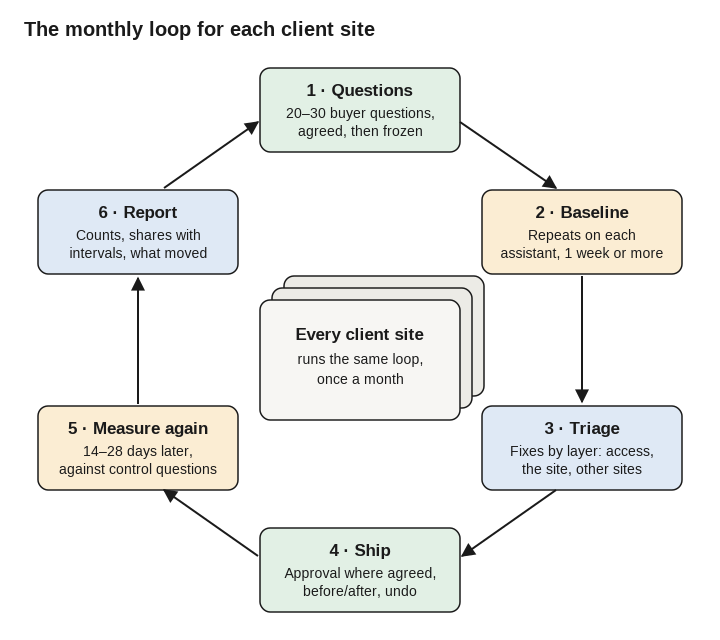
It is a loop of six steps: questions, baseline, triage, ship, measure again and report, once a month. The first month is mostly setup; from the second month on, each cycle adds a few changes and checks the ones that went live 14 to 28 days before.
- Questions. Agree 20 to 30 buyer questions with the client, then freeze them.
- Baseline. Ask each one several times on each assistant, for at least a full week, and record who is named and which pages are cited.
- Triage. Sort the possible fixes by layer: access, the client's site, other sites.
- Ship. Make each change with the client's approval where agreed, with a record of before and after and a way to undo it.
- Measure again. Compare the questions each change could affect with control questions, 14 to 28 days after it went live.
- Report. Once a month: counts, shares with intervals, what changed, what moved and what did not.
The same loop works for a clinic, a shop and a software company. What changes between clients is the questions, the connection to their site and who has to approve what.
How do you choose buyer questions for each client?
Start from the client's sales conversations, not from a keyword tool. A buyer question is what someone types just before choosing: the service, the place, the kind of customer, and a request to pick one.
Wording changes the answer. In a September 2026 paper, Malthouse and colleagues tested six models across five product categories. Questions naming only a category showed "substantial omission of established brands". Questions that included the user's goals and constraints changed which brands came back. So write questions the way a buyer with a real need would ask them.
A mix that covers the client's market
- Purchase questions with a need and a place. Example (invented): "Which dental clinic in Leeds does clear aligners for adults and opens on Saturdays?"
- Comparison questions naming a competitor the client loses to. Example (invented): "Is there a cheaper alternative to [competitor] for small offices?"
- Brand questions about the client by name. Example (invented): "Is [clinic name] a good choice for implants?" These show how the assistants describe the client, not whether they recommend it.
Rules that keep the set comparable
- Use the buyers' language and country. A clinic in Valencia gets Spanish questions asked from Spain.
- Freeze the set. Changing one word changes the measurement. Review the set each quarter, not each week, and log the date of every change.
- Don't promise volumes. CitedIn shows no prompt volumes because it has no source for them. If a tool shows them, ask the vendor where the figures come from before you put them in a client report.
How do you take a baseline you can trust?
Ask each question several times, on each assistant, spread over at least a week. One run per question gives you an anecdote per question, because the lists of brands change almost every time.
In SparkToro's study, published on 28 January 2026 with Gumshoe.ai (a tracking vendor, disclosed in the post), 600 volunteers ran 12 prompts through ChatGPT, Claude and Google's AI 2,961 times. Two runs gave the same brand list less than 1 time in 100. How often a brand appeared was far steadier, and the authors concluded that "visibility % across dozens to hundreds of prompts run multiple times is a reasonable metric."
How many answers per figure
The margin around a share depends on how many answers sit behind it. At a share near 50 %, 30 answers carry a 95 % margin of about ±18 points; 90 answers about ±10; 450 answers about ±5. Our arithmetic: 1.96 × √(0.25 ÷ answers). Thirty questions asked three times each give 90 answers per assistant, which is enough to see moves of about 15 points between two periods.
Measure the apps, not only the API
A September 2026 audit by Uberti-Bona Marin and colleagues compared ChatGPT and Gemini through their apps and their APIs. The APIs cited different sources from the apps: mean domain overlaps of 12.0 % for ChatGPT and 14.8 % for Gemini. The authors conclude that "neither isolated responses nor API observations can be assumed to represent the commercial advice consumers encounter." Your client's buyers use the apps.
Control what you can
- Country. ChatGPT "may share that general location with third-party search providers", based on IP address, so ask from the client's market.
- Memory. "If memory is enabled, ChatGPT may use relevant saved memories when rewriting a search query." Use a clean account or memory off.
- Cited pages. Record the pages cited in every answer. That list is the map for the triage step.
Which fixes should you make first?
Fix access first, then the client's own pages, then the other sites the assistants cite. Access is quick and has the strongest evidence; other sites are slow and mostly outside your control.
| Layer | What to check | What the evidence says | Who usually fixes it |
|---|---|---|---|
| Crawler access | robots.txt groups for OAI-SearchBot and PerplexityBot; CDN and firewall rules; noindex | OpenAI: sites opted out of OAI-SearchBot "will not be shown in ChatGPT search answers"; Google: a page must be "indexed and eligible to be shown in Google Search with a snippet" | The agency, in hours |
| What the site says | A plain first sentence on each main page; one page per service; prices, areas, who it is for | Google: "no additional requirements" and no special markup for its AI features; plain pages are an editorial convention, not a documented factor | The agency with the client's approval |
| Other sites cited | Directories, review sites, comparisons, forums and videos the assistants cite for the client's questions | ChatGPT and Gemini shared 5.4 % of cited domains on average for the same query (2026 audit) | The client, PR or outreach, over months |
Sources: OpenAI crawler documentation; Google Search Central; Uberti-Bona Marin et al. (2026); all read 2026-11-24.
Layer 1: can the assistants read the site?
Check robots.txt for each search crawler, then the CDN or firewall, then noindex on the pages you want quoted. OpenAI says a robots.txt change takes "~24 hours" to apply in ChatGPT search, and asks that hosts allow requests from its published IP ranges. Perplexity says PerplexityBot "is designed to surface and link websites in search results on Perplexity. It is not used to crawl content for AI foundation models." It also asks site owners to allow its published IP ranges in firewalls.
Keep two crawlers apart in client conversations. GPTBot "is used to crawl content that may be used in training", so blocking it is a licensing choice, not a visibility one. Perplexity-User, which fetches a page when a person asks, "generally ignores robots.txt rules". For the full list of crawlers and a robots.txt you can adapt per client, see which AI crawlers to allow or block.
Layer 2: does the site say what the client does, where and for whom?
Rewrite the first sentence of each main page so it names the service, the place and the customer. Give each service its own page. Google says "There are no additional requirements to appear in AI Overviews or AI Mode, nor other special optimizations necessary", and that you don't need "AI text files, or markup". Don't sell llms.txt or new schema types as an AI fix. For a version of this layer you can hand to a client, see how to get a business mentioned in ChatGPT.
Layer 3: which other pages do the assistants read about the client?
Use the cited pages from the baseline, per assistant. Because ChatGPT and Gemini cite such different domains for the same query, a directory that matters on one assistant may never appear on another. Correct wrong facts on the pages that come up often; leave the rest. This layer is slow and is where an agency's people beat any software: outreach, partnerships and PR.
How to order the list
Score each candidate fix on three things: how many of the client's questions it could affect, whether a competitor is named where the client is not, and the effort. A blocked crawler touches every question and takes an hour. A new comparison page touches three questions and takes a week. Do the first one first.
To see a client's starting point before a pitch, the free analysis asks ChatGPT, Perplexity and Google AI Overviews 8 buyer questions about the site: 24 answers. At 24 answers the margin is about ±20 points, so use it to open the conversation, not as the baseline.
How do you ship fixes with approvals and undo?
Agree in writing which changes need the client's sign-off, and keep a record of every change: before, after, who approved it, the date it went live and how to undo it. That record is what lets you measure each change again and defend it later.
On sites in a code repository
Ship each change as a pull request, never as a direct commit. GitHub lets a repository require "a specific number of approving reviews before someone merges the pull request into a protected branch". It also lets you require status checks to pass before merging. The client's developer stays in charge of what goes live.
On WordPress
WordPress keeps revisions: "The WordPress revisions system stores a record of each saved draft or published update", with a Restore button. By default it tracks "title, author, content, excerpt". A change stored elsewhere needs its own record of before and after: an SEO plugin's title field, a robots.txt rule or structured data added by a plugin. Publish new pages as drafts first, so the client sees them before buyers do.
Approval levels that clients accept
- Small, reversible edits (a meta description, a robots.txt line): ship and report.
- Visible text on main pages: ship after the client approves.
- New pages, prices, claims about the business: always the client's decision.
Write down what the agency will never touch, such as orders, customers, payments, plugins and the theme. It costs one line in the contract and saves the hardest conversation.
When and how do you measure a fix again?
Measure again 14 to 28 days after the change goes live, with the same questions, and compare the questions it could affect with control questions it could not. Measuring the next day measures nothing: Google says "Crawling can take anywhere from a few days to a few weeks."
Why the control set matters
Assistants change under you: models are updated, search results shift, competitors publish. If the affected questions rise 15 points and the control questions rise 12, the fix explains about 3 points, not 15. Group changes by the questions they touch, so each change keeps some questions that it cannot affect.
A worked example of an honest result
Example (invented figures): in September ChatGPT named a client in 18 of 90 answers (20 %; 95 % confidence interval 13 % to 29 %). In October, after a fix, it named the client in 27 of 90 (30 %; 22 % to 40 %). The intervals overlap. A two-proportion test gives about 1.55, below the 1.96 needed at 95 %. The honest report says: "up 10 points, not yet distinguishable from chance; measured again next month." That sentence keeps the client's trust when the next month is flat.
What goes in a monthly client report?
Counts, shares with intervals, who was named instead, which pages were cited, what changed on the site and what each measured change showed. Leave out anything you cannot trace to an answer.
Put in
- Per assistant: named in X of Y answers, the share, its 95 % confidence interval, and last month's figure.
- Who was named instead, with counts, and which of the client's questions they won.
- Pages cited, the client's and other sites'.
- Changes shipped: date live, pages, the questions each should affect, and its status: "moved", "no clear move" or "too early".
- Next month: the next three fixes and what the client needs to approve.
Leave out
- A 0 to 100 "AI score" whose inputs the client cannot see.
- A "position" read from one answer per question.
- Traffic or revenue forecasts from AI mentions.
- Prompt volumes without a named source.
Google's guide for site owners hiring an SEO tells them to ask about expected results and timeframes, how success is measured, and whether the agency will explain every change it makes. A report built this way answers all three before the client asks.
How do you price AI visibility work to clients?
Price the routine, not an outcome. Build the fee from three parts: the tool's cost per site, your hours per month, and any outreach on other sites as its own line. We found no verifiable public benchmark for what agencies charge for this, so this post gives none.
What not to sell
Don't sell guaranteed mentions. OpenAI says of ChatGPT search that "Placement is not guaranteed", and Google says no one can guarantee a top ranking in its results. A guarantee you cannot keep turns a good month of work into a refund.
Common structures
- Setup fee for the questions, the baseline and the access fixes, which are front-loaded.
- Monthly retainer per site for measurement, triage, shipped changes and the report.
- Separate project for outreach and PR on other sites, with its own scope.
The tool cost, worked out
CitedIn's list prices on 27 November 2026 are per site, graduated per account, before VAT: US$79 a month for the 1st site, US$49 for sites 2 to 5, US$39 for sites 6 to 20 and US$35 from the 21st (€72, €45, €36 and €32; £62, £39, £31 and £28). "Agency" is the name of the rates from the 6th site, not a separate plan. For 10 client sites: 79 + 4 × 49 + 5 × 39 = US$470 a month (€432, £373), about US$47 a site. Paying yearly costs ten months. There is a 14-day free trial (card required, nothing charged during the trial).
Where does this method stop working?
It works least where assistants rarely name anyone, and where the problem lives on other people's sites. Tell the client early.
- Thin niches. If almost no answer names any business, shares sit near 0 % and intervals stay wide for months.
- Reputation elsewhere. No edit on the client's site changes what a large directory or forum says.
- Locked sites. Page builders, closed themes or no developer access slow every change.
- Drift. A fix that worked can fade when an assistant changes; keep measuring after the win.
Where does CitedIn fit in an agency's routine?
CitedIn runs the measurement and much of the fixing for each client site; the agency keeps the client relationship, the judgement and the work on other sites. That split is deliberate: an agency can do things CitedIn doesn't.
- Measurement: 30 buyer questions per site (25 purchase, 5 brand), each asked 3 times per assistant every week on ChatGPT, Google AI Overviews, Google AI Mode, Perplexity and Gemini: 450 answers a week, with 95 % confidence intervals. It shows who the assistants name instead, which pages they cite and how they describe the client.
- Fixes, in a working mode per site: On its own, I check the big changes, or Ask me first. On WordPress it changes meta descriptions, opening paragraphs and internal links; with the free CitedIn Connect plugin also schema, robots.txt, redirects and the text of Elementor Heading and Text Editor widgets. Longer texts and new pages are always drafts, and every change has a 30-day undo. Text in Divi, WPBakery, Bricks or other Elementor widgets becomes a task for a person. On GitHub it opens pull requests (never a direct commit, never a merge) or issues when a person is needed.
- Measured again: each change 14 to 28 days after it goes live, affected against control questions.
- Reports: a monthly report per site, with a read-only share link valid for 30 days that you can send to the client.
- If a client leaves: the changes stay on the site; they are normal edits or merged pull requests.
Where others fit better: CitedIn does not measure Claude or Copilot, and Shopify, Wix, Webflow and Squarespace are not available yet. If a client needs those, use a tool that covers them.
You can read what CitedIn offers agencies, how the measurement works and the per-site prices.
Sources
- arXiv, Malthouse et al., "Evaluating Brand Retrieval and Ranking in Large Language Model Recommendations" (2026), https://arxiv.org/abs/2609.16304 (read 2026-11-24)
- arXiv, Uberti-Bona Marin et al., "'If I Had to Buy Just ONE: Galaxy S26 Ultra': Auditing AI-Generated Product Recommendations" (2026), https://arxiv.org/abs/2609.18729 (read 2026-11-24)
- SparkToro (Rand Fishkin), "New research: AIs are highly inconsistent when recommending brands or products", https://sparktoro.com/blog/new-research-ais-are-highly-inconsistent-when-recommending-brands-or-products-marketers-should-take-care-when-tracking-ai-visibility/ (read 2026-11-24)
- OpenAI, crawler documentation (OAI-SearchBot, GPTBot), https://developers.openai.com/api/docs/bots (read 2026-11-24)
- OpenAI Help Center, "Searching the web with ChatGPT", https://help.openai.com/en/articles/9237897-searching-the-web-with-chatgpt (read 2026-11-24)
- Perplexity, "Perplexity Crawlers", https://docs.perplexity.ai/guides/bots (read 2026-11-24)
- Google Search Central, "AI features and your website", https://developers.google.com/search/docs/appearance/ai-features (read 2026-11-24)
- Google Search Central, "Ask Google to recrawl your website", https://developers.google.com/search/docs/crawling-indexing/ask-google-to-recrawl (read 2026-11-24)
- Google Search Central, "Do you need an SEO?", https://developers.google.com/search/docs/fundamentals/do-i-need-seo (read 2026-11-24)
- GitHub Docs, "About protected branches", https://docs.github.com/en/repositories/configuring-branches-and-merges-in-your-repository/managing-protected-branches/about-protected-branches (read 2026-11-24)
- WordPress.org Documentation, "Revisions", https://wordpress.org/documentation/article/revisions/ (read 2026-11-24)
- CitedIn, prices and product behaviour as published on citedin.io and in the product, 24 November 2026